
 Back to List
Customer Voice | 100+ ESTUN Robots Inject New AI Momentum into Ferrous Metal Grinding!
 Publish Date:Jul 1,2026
Brake discs, steering knuckles, exhaust pipes, and other ferrous metal parts have high hardness and large grinding removal volumes. Complex deep cavities and corner dead zones have long been industry pain points in automated grinding. A professional grinding special machine manufacturer had long been trapped in the dilemma of "special machines covering main processes while dead zones rely entirely on manual supplementary grinding." When orders surged, manual production capacity could not keep up, grinding accuracy was unstable, and changeover commissioning took a long time, becoming a core problem restricting capacity expansion. However, an AI intelligent grinding solution built on algorithms and digital capabilities can precisely compensate for the shortcomings of manual operations in an all-round way and achieve high-quality, efficient, and stable mass production.
In early 2026, based on years of experience deeply rooted in the metal grinding industry, ESTUN reached in-depth cooperation with this professional grinding special machine manufacturer. More than 100 ESTUN heavy-load grinding robots were fully deployed on the production line. Relying on self-developed hardware, customized processes, and AI digital capabilities, it provides a one-stop solution to the full-process pain points of ferrous metal grinding.
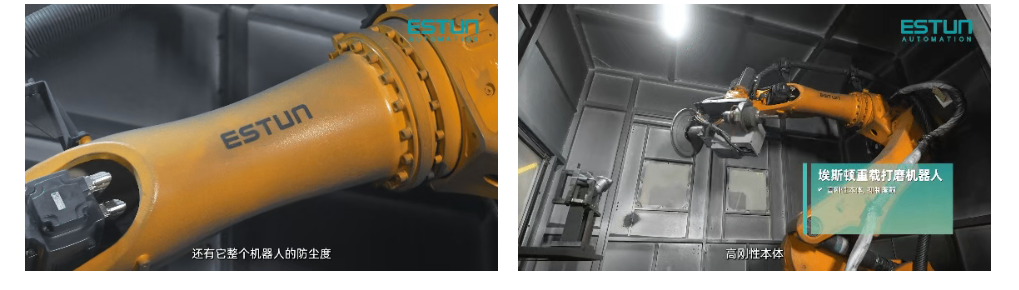
High-Rigidity Body, Adapting to High-Load Grinding Conditions
Ferrous metal grinding involves heavy dust and continuous strong stress. The ESTUN ER220-2700 heavy-load robot is specifically matched to high-intensity operation requirements:
High-rigidity body: Effectively suppresses deformation and chatter during grinding, providing a stable mechanical foundation for precise AI execution.
Full dynamics algorithm: Combined with high-performance motors, it provides sufficient torque and ensures continuous and stable operation under high cycle rates.
Top-level protection: Wrist IP67 protection rating, unafraid of high-dust environments.
AI force control compensation: Based on real-time force feedback data, the AI algorithm dynamically adjusts grinding pressure, with precision controlled within ±2%, ensuring uniform grinding without residue.
Large reach coverage: 2700 mm reach, easily covering all grinding positions of large workpieces.
Intelligent Deviation Correction, Significantly Improved Changeover Efficiency
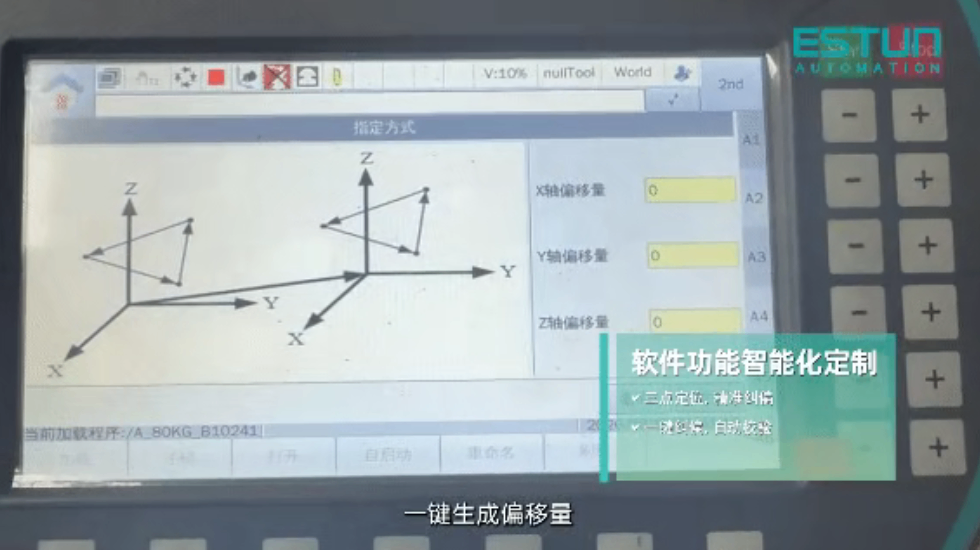
In response to the on-site problems of frequent changeovers and fixture offset, ESTUN abandoned the industry's common two-point deviation correction and independently developed a three-point positioning algorithm, greatly improving positioning accuracy. Equipped with a one-click deviation correction intelligent function, the system automatically collects coordinates, calculates, and generates offset parameters, simplifying operation steps and greatly lowering the manual operation threshold.
On-site actual measurement showed that after the deviation correction function was implemented, workpiece teaching time was directly shortened by 60%, multi-station programs can be quickly reused, and flexible production of multiple types of parts is easily handled.
AI Offline Programming, Simulation and Optimization of Complex Paths in Advance
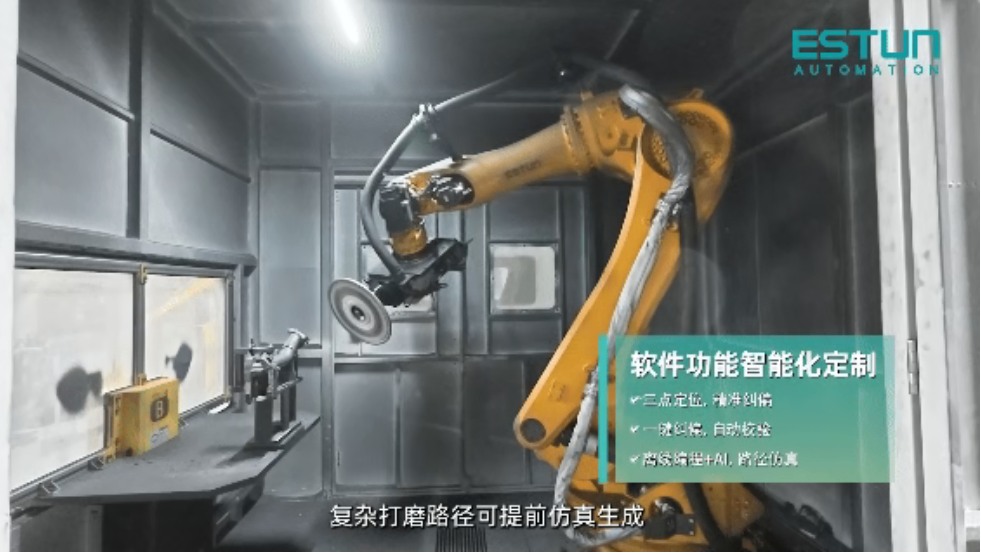
The intelligent core of ESTUN's grinding solution comes from offline programming software integrated with AI trajectory optimization. In the past, grinding paths for complex cavities and special-shaped corners required workers to repeatedly teach and debug on site. Now, workpiece models can be directly imported, and the AI algorithm automatically derives the optimal grinding trajectory, completing collision simulation and path smoothing optimization in advance without occupying physical production line debugging.
Relying on AI trajectory planning capabilities, customers' new order commissioning cycles are shortened by an average of more than 50%, greatly reducing production line downtime and waiting time.
The customer's responsible person said: "More than 100 ESTUN robots have been running stably for more than half a year. The most intuitive change is the dual improvement in equipment usability and grinding finished product quality. The robot's grinding trajectory is smooth and neat, product yield and delivery rhythm are fully stabilized, and overall production capacity has increased by more than 30% compared with the manual supplementary grinding stage."
In addition to hardware and software advantages, ESTUN's R&D and service teams quickly respond to customized needs, continuously iterate grinding process solutions, and ensure stable production throughout the production line.
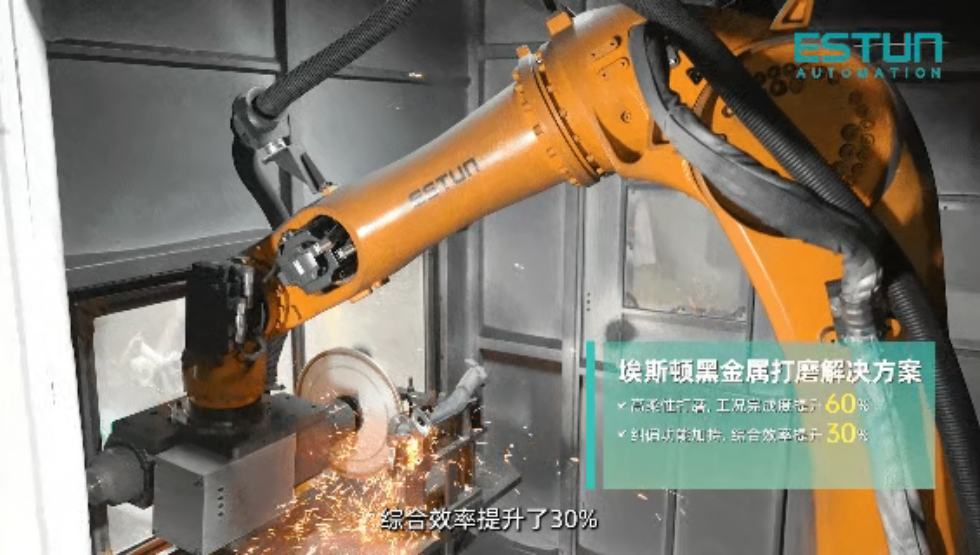
The three major industry challenges of ferrous metal high hardness, high precision, and high-frequency changeover are being solved one by one by ESTUN robots. From single-unit pilot to large-scale deployment of 100 units, ESTUN uses heavy-load rigid bodies, customized process algorithms, and AI offline simulation digital solutions to fill the shortcomings of automotive parts grinding automation, uses AI intelligent technology to solve the "dead zone problem" of production lines, and injects new momentum into the intelligent upgrading of automotive parts manufacturing.


